

Keywords
Shelters
Termite mounds
Echimyidae
Dry Forest
How to Cite
Accepted 2024-07-30
Published 2024-11-06



Abstract
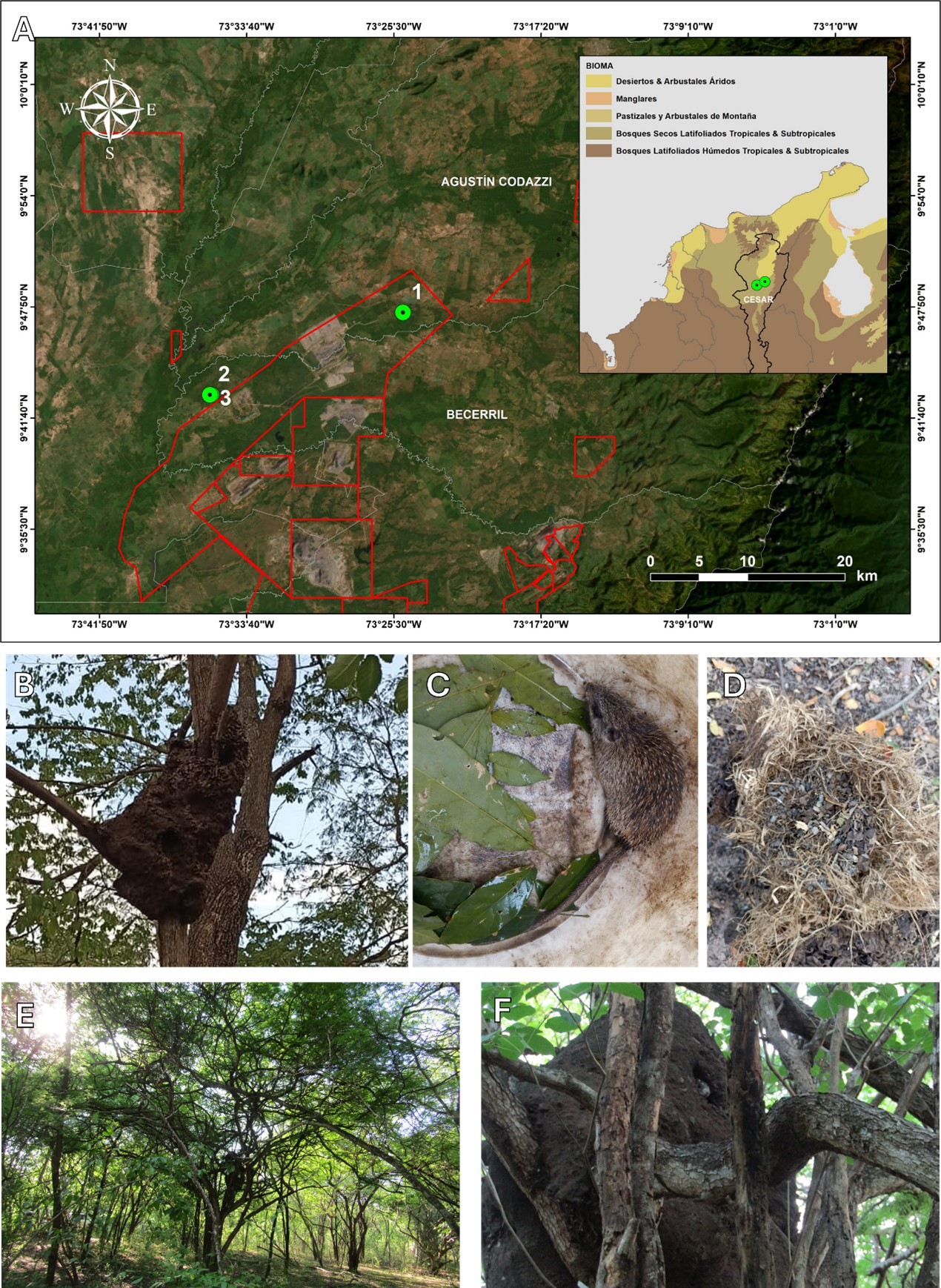
We recorded the use of termite mounds as shelters by the Arboreal Spiny Rat (Pattonomys semivillosus) in Colombian Tropical dry forests, an endemic and a poorly studied species with significant gaps minding in its natural history. Data were collected through observations in occasional encounters during mammal surveys and a wildlife removal and relocation projects. Three events were recorded of P. semivillosus using active termite mounds, behaviour did not record previously, which represents a breakthrough in ecological traits of the species. With this note, we highlight the necessity of additional research, to enhance the understanding of the importance of these structures in the survival of this arboreal species in one of the most threatened ecosystems on the planet.
References
Aguilera M. 2016. Pattonomys semivillosus. The IUCN Red List of Threatened Species 2016: e. T90386452A22212633. https://dx.doi.org/10.2305/IUCN.UK.20162.RLTS.T90386452A22212633
Ballesteros-Correa J, Morelo-García L, Pérez-Torres J. 2019. Composición y estructura vegetal de fragmentos de bosque seco tropical en paisajes de ganadería extensiva bajo manejo silvopastoril y convencional en Córdoba, Colombia. Caldasia 41:224–234. https://doi.org/10.15446/caldasia.v41n1.71320
Brightsmith DJ. 2004. Nest sites of termitarium nesting birds in SE Peru. Ornitologia Neotropical, 15, 319-330.
Chacón-Pacheco JJ, Lozano-Flórez J, Avendaño-Maldonado LJ, Racero-Casarrubia J, Montoya-Patiño L., Ramírez-Chaves HE. 2022. Rarity and conservation status of the Colombian Speckled Tree Rat, Pattonomys semivillosus (I. Geoffroy, 1838). Mammalia, 87(1), 34-40. https://doi.org/10.1515/mammalia-2022-0070
Dechmann DK, Kalko EK, Kerth G. 2004. Ecology of an exceptional roost: energetic benefits. Evolutionary Ecology Research, 6(7), 1037-1050.
Dinerstein E, Olson D, Joshi A, Vynne C, Burgess ND, Wikramanayake E, ... & Saleem M. 2017. An ecoregion-based approach to protecting half the terrestrial realm. BioScience, 67(6), 534-545. https://doi.org/10.1093/biosci/bix014
Emmons LH, Fabre PH. 2018. A review of the Pattonomys/Toromys clade (Rodentia: Echimyidae), with descriptions of a new Toromys species and a new genus. American Museum Novitates, 2018(3894), 1-52. https://doi.org/10.1206/3894.1
Emmons LH, Patton JL. 2015. Genus Pattonomys. In: Patton JL, Paridas U, D’Elía G. (Editors). Mammals of South America, Volume 2: rodents. The University of Chicago Press, Chicago, p. 910–915.
Esquivel DA, Peña S, Aya-Cuero C, da Cunha Tavares V. 2020. Bats and termite nests: roosting ecology of Lophostoma brasiliense (Chiroptera: Phyllostomidae) in Colombia. Mastozoología neotropical, 27(1), 72-80. https://doi.org/10.31687/saremMN.20.27.1.0.11
Fabre PH, Patton JL, Leite YLR, Wilson DE, Lacher TE, Mittermeier RA. 2016. Family Echimyidae. Handbook of the mammals of the world, 6, 552-641.
Fleming PA, Loveridge JP. 2003. Miombo woodland termite mounds: resource islands for small vertebrates?. Journal of Zoology, 259(2), 161-168. https://doi.org/10.1017/S0952836902003084
Gómez F. 2014. Metodologías para el monitoreo de la biodiversidad en la Amazonía. In: Programa de Monitoreo de la Biodiversidad, editores. Metodologías Para el Monitoreo de la Biodiversidad en la Amazonía. Perú: Consorcio Camisea. p. 111–122. https://doi.org/10.1088/1748-9326/9/3/034012
Hernández-Mijangos LA. 2010. Uso de termitero como refugio por Artibeus lituratus (Chiroptera: Phyllostomidae). Revista Mexicana de Mastozoología (Nueva Época), 14(1), 59-63. https://doi.org/10.22201/ie.20074484e.2010.14.1.28
Jessen RR, Palmer GH, Koprowski JL. 2013. Neotropical pygmy squirrels (Sciurillus pusillus) share termite nests. Ecotropica, 19(1-2), 73-76.
José H, Macedo I, Loss MC. 2019. A new and simple method to capture small arboreal mammals: the suspended pitfall. Rev. Bras. Zoociencias 20: 1–14. https://doi.org/10.34019/2596-3325.2019.v20.24790
Kalko EK, Ueberschaer K, Dechmann D. 2006. Roost Structure, Modification, and Availability in the White‐throated Round‐eared Bat, Lophostoma silvicolum (Phyllostomidae) Living in Active Termite Nests 1. Biotropica: The Journal of Biology and Conservation, 38(3), 398-404. https://doi.org/10.1111/j.1744-7429.2006.00142.x
Lasso CA. 2014. Descripción metodológica para la evaluación biológica en los complejos de humedales. http://doi.org/hdl.handle.net/20.500.11761/9591
Mejía-Correa S. 2018. Nuevos registros e historia natural de Pattonomys semivillosus (I. Geoffroy, 1838) (Rodentia: Echimyidae) en relictos de bosque seco tropical de los departamentos de Bolívar y Atlántico, Colombia. Mammalogy Notes, 5(1-2), 12-14. https://doi.org/10.47603/manovol5n1.12-14
Pizano C, García H. 2014. El bosque seco tropical en Colombia. Instituto de investigación de recursos biológicos Alexander von Humboldt (IAvH), Bogotá, D.C.
Posada SE, Vides HA, Plazas GG. 2019. Caracterización de la fauna asociada al Club Lagos de Caujaral, Puerto Colombia, Atlántico: Informe técnico. Galbula Consultoría Especializada. SAS.
Racero-Casarrubia J, Calvano-Zúñiga A, Tortello-Ditta M, Téllez-Wenster L, Viloria-Lagares T, Cogollo KR, Pacheco JJC. 2024. Mamíferos en áreas de monitoreo y compensación asociadas a complejos mineros al nororiente de Colombia. Biota Colombiana, 25, e1133. https://doi.org/10.21068/2539200X.1133
Rangel-Ch JO. 2019. Clima integrado de la serranía de Perijá, Colombia. En J.O. Rangel-Ch., M.G. Andrade-C., C. Jarro-F. & G. Santos-C. (eds). Colombia Diversidad Biótica XVIII. Biodiversidad y territorio de la serranía de Perijá (Cesar-Colombia): 93-128. Universidad Nacional de Colombia - Instituto de Ciencias Naturales. Bogotá D.C.
Sánchez-Soto S, Sánchez-Gómez WS, Pérez-Castro AJ. 2022. Artibeus jamaicensis (Chiroptera: Phyllostomidae) utilizando un termitero arbóreo como refugio diurno en Tabasco, México. Mammalogy Notes, 8(1), 277-277. https://doi.org/10.47603/mano.v8n1.277
Solari S, Muñoz-Saba Y, Rodríguez-Mahecha JV, Defler TR, Ramírez-Chaves HE, Trujillo F. 2013. Riqueza, endemismo y conservación de los mamíferos de Colombia. Mastozoología neotropical, 20(2), 301-365.
Teta P, Quiroga-Carmona M, D’Elía G. 2022. Imperiled or not? Characterizing the non-charismatic and data deficient South American rodents. https//doi.org/10.1016/B978-0-12-821139-7.00049-0.g

This work is licensed under a Creative Commons Attribution 4.0 International License.