

Keywords
diet
foraging
modified environment
protein
How to Cite
Accepted 2026-04-02
Published 2026-10-14



Abstract
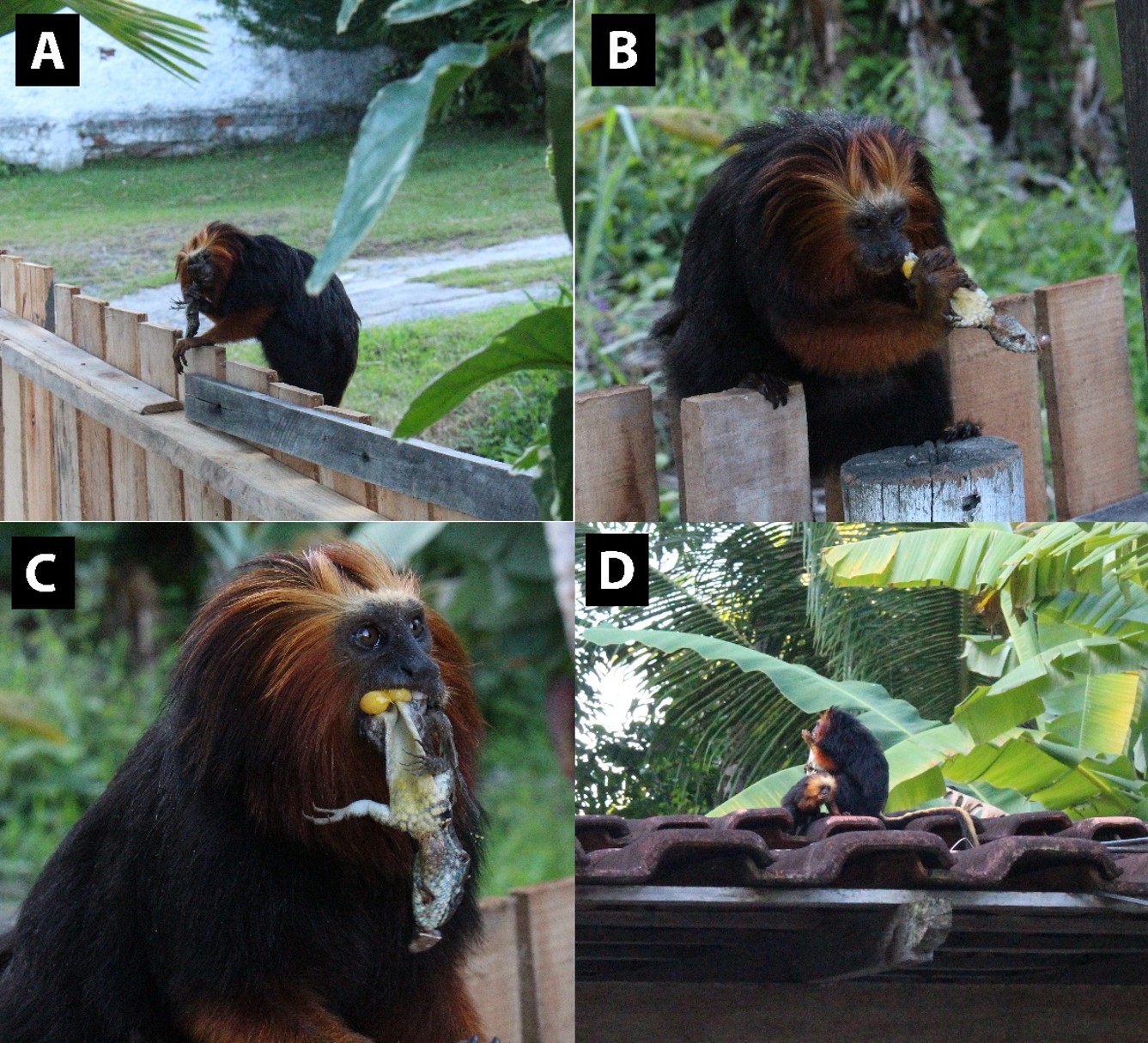
Predation events involving vertebrates are rarely observed in wild primates, however they provide valuable insights into foraging strategies, dietary supplementation, and trophic interactions. Callitrichid primates are predominantly omnivorous, relying mainly on fruits and invertebrates, while vertebrate prey represents an important but poorly documented source. Here, we report the first documented case of predation on a lizard, Tropidurus torquatus, by the endangered golden-headed lion tamarin Leontopithecus chrysomelas, an endemic species of the Atlantic Forest. The opportunistic event was observed in November 2025 in a rural area of Ilhéus, southern Bahia, Brazil, within a mosaic of forest remnants and anthropogenic elements. An adult tamarin captured, killed, and partially consumed the lizard, initiating feeding with the visceral contents before the prey was taken by another group member and fullyconsumed. The predation event occurred in a modified microhabitat associated with coconut palms, highlighting the use of anthropogenic elements during foraging. This record expands current knowledge of the diet of L. chrysomelas, provides species-level identification of a vertebrate prey item, and reinforces the role of opportunistic vertebrate predation as a complementary foraging strategy in callitrichid primates.
References
Bufalo FS, Galetti M, Culot L. 2016. Seed dispersal by primates and implications for the conservation of a biodiversity hotspot, the Atlantic Forest of South America. International Journal of Primatology 37:333–349. https://doi.org/10.1007/s10764-016-9903-3
Butynski TM. 1982. Vertebrate predation by primates: a review of hunting patterns and prey. Journal of Human Evolution 11:421–430.
Carvalho ALG, Britto MR, Fernandes DS. 2013. Biogeography of the lizard genus Tropidurus Wied-Neuwied, 1825 (Squamata: Tropiduridae): distribution, endemism, and area relationships in South America. PLOS ONE 8(3):e59736.
Catenacci LS, Pessoa MS, Nogueira-Filho SLG, Vleeschouwer KM. 2016. Diet and feeding behavior of Leontopithecus chrysomelas (Callitrichidae) in degraded areas of the Atlantic Forest of South Bahia, Brazil. International Journal of Primatology 37:136–157. https://doi.org/10.1007/s10764-016-9889-x
Chapman CA, Onderdonk DA. 1998. Forests without primates: primate–plant codependency. American Journal of Primatology 45:127–141. https://doi.org/10.1002/(SICI)1098-2345(1998)45:1<127::AID-AJP9>3.0.CO;2-Y
Chaves ÓM, Morales-Cerdas V, Calderón-Quirós J, Azofeifa-Rojas I, Riba-Hernández P, Solano-Rojas D, Chaves-Cordero C, Chacón-Madrigal E, Melin AD. 2023. Plant diversity in the diet of Costa Rican primates in contrasting habitats: a meta-analysis. Diversity 15:602. https://doi.org/10.3390/d15050602
Coimbra-Filho AF, Mittermeier RA. 1973. Distribution and ecology of the genus Leontopithecus Lesson, 1840 in Brazil. Primates 14:47–66.
Dias PAD, Arroyo-Rodríguez V, Rangel-Negrín A. 2025. Demografía de primates: censando el dosel del bosque. Therya Ixmana 4(3):218-220. https://doi.org/10.12933/therya_ixmana-25-766
Garbino GST, Rezende GC, Antônio DC, Bufalo F, Amaral RG, Silva ASA. 2022. Seasonal variation in frog predation by black lion tamarins (Leontopithecus chrysopygus). Journal of Natural History 56:449–461. https://doi.org/10.1080/00222933.2022.2078242
Gittleman JL (ed.). 1989. Carnivore behavior, ecology, and evolution. Springer, Boston.
Guilherme E, Canizo R, Araújo JDS. 2016. Predation of a lizard (Plica umbra) by pygmy marmosets (Cebuella pygmaea) in a forest fragment in southwestern Brazilian Amazon. Neotropical Primates 23:38–40.
Hawes, JE, Calouro, AM, Peres, CA. 2013. Sampling effort in Neotropical primate diet studies: Collective gains and underlying geographic and taxonomic biases. International Journal of Primatology 34:1081–1104. https://doi.org/10.1007/s10764-013-9738-0
Heymann EW, Knogge C, Tirado Herrera ER. 2000. Vertebrate predation by sympatric tamarins, Saguinus mystax and Saguinus fuscicollis. American Journal of Primatology 51:153–158.
Janson CH, Chapman CA. 1999. Resources and primate community structure. In: Fleagle JG, Janson CH, Reed KE (eds.), Primate communities. Cambridge University Press, Cambridge, p. 237–267.
Kaizer MC, Sales NG, Alvim THG, Strier KB, Melo FR, Boubli JP, Young RJ, McDevitt AD. 2025. Assessing group size and the demographic composition of a canopy-dwelling primate, the northern muriqui (Brachyteles hypoxanthus), using arboreal camera trapping and genetic tagging. Remote Sensing in Ecology and Conservation. https://doi.org/10.1002/rse2.70035
LaBarge LR, Hill RA, Berman CM, Margulis SW, Allan ATL. 2020. Anthropogenic influences on primate antipredator behavior and implications for research and conservation. American Journal of Primatology 82:e23087. https://doi.org/10.1002/ajp.23087
Lambert JE, Rothman JM. 2015. Fallback foods, optimal diets, and nutritional targets: primate responses to varying food availability and quality. Annual Review of Anthropology 44:493–512. https://doi.org/10.1146/annurev-anthro-102313-025928Mariau D. 2001. The fauna of oil palm and coconut: insect and mite pests and their natural enemies. Editions Quae, Paris.
Milton K. 1981. Food choice and digestive strategies of two sympatric primate species. The American Naturalist 117:496–505.
Oliveira LC, Neves LG, Kierulff MCM, Jerusalinsky L, Mittermeier RA, Rylands AB. 2021. Leontopithecus chrysomelas (amended version of 2020 assessment). The IUCN Red List of Threatened Species 2021:e.T40643A192327573. https://doi.org/10.2305/IUCN.UK.2021-1.RLTS.T40643A192327573.en
Raboy BE, Christman, MC, Dietz, JM. 2004. The use of degraded and shade cocoa forests by endangered golden-headed lion tamarins (Leontopithecus chrysomelas). Oryx, 38 (1): 75–83. https://doi.org/10.1017/S0030605304000122
Raboy BE, Dietz JM. 2004. Diet, foraging, and use of space in wild golden-headed lion tamarins. American Journal of Primatology 63:1–15.
Rodewald AD, Kearns LJ, Shustack DP. 2011. Anthropogenic resource subsidies decouple predator–prey relationships. Ecological Applications 21:936–943.
Rodrigues MT. 1987. Sistemática, ecologia e zoogeografia dos Tropidurus do grupo torquatus ao sul do Rio Amazonas (Sauria, Iguanidae). Arquivos de Zoologia 31(3):105–230.
Rose LM. 1997. Vertebrate predation and food-sharing in Cebus and Pan. International Journal of Primatology 18:727–765.
Rossi N, Chiaraviglio M, Cardozo G. 2023. Behavioural plasticity in activity and sexual interactions in a social lizard at high environmental temperatures. PLoS ONE 18:e0285656. https://doi.org/10.1371/journal.pone.0285656
Schaller GB. 1976. The Serengeti lion: a study of predator–prey relations. University of Chicago Press, Chicago.
Teixeira JVS, Raboy BE, Oliveira LDC. 2025. Reassessing distribution and population estimates of the golden-headed lion tamarin Leontopithecus chrysomelas (Primates, Callitrichidae). Endangered Species Research 57:481–495. https://doi.org/10.3354/esr01424
Teixeira JVS, Bonfim FCG, Vancine MH, Ribeiro MC, Oliveira LC. 2024. Effect of landscape attributes on the occurrence of the endangered golden-headed lion tamarin in southern Bahia, Brazil. American Journal of Primatology 86(4):e23588. https://doi.org/10.1002/ajp.23588
Vasquez VL, Beltrão-Mendes R, Pinto MP. 2025. Atlantic Forest primates and their main food resources. Mammal Review 55:e12378. https://doi.org/10.1111/mam.12378
Mamalogy Notes is a publication from Sociedad Colombiana de Mastozoología (SCMas) and it is distributed unde a licence: Creative Commons Attribution 4.0 International (CC BY 4.0) which permits unrestricted use, distribution and reproduction in any medium. Copyright belongs to the authors who submit the work.