

Keywords
How to Cite
Accepted 2026-01-22
Published 2026-10-14



Abstract
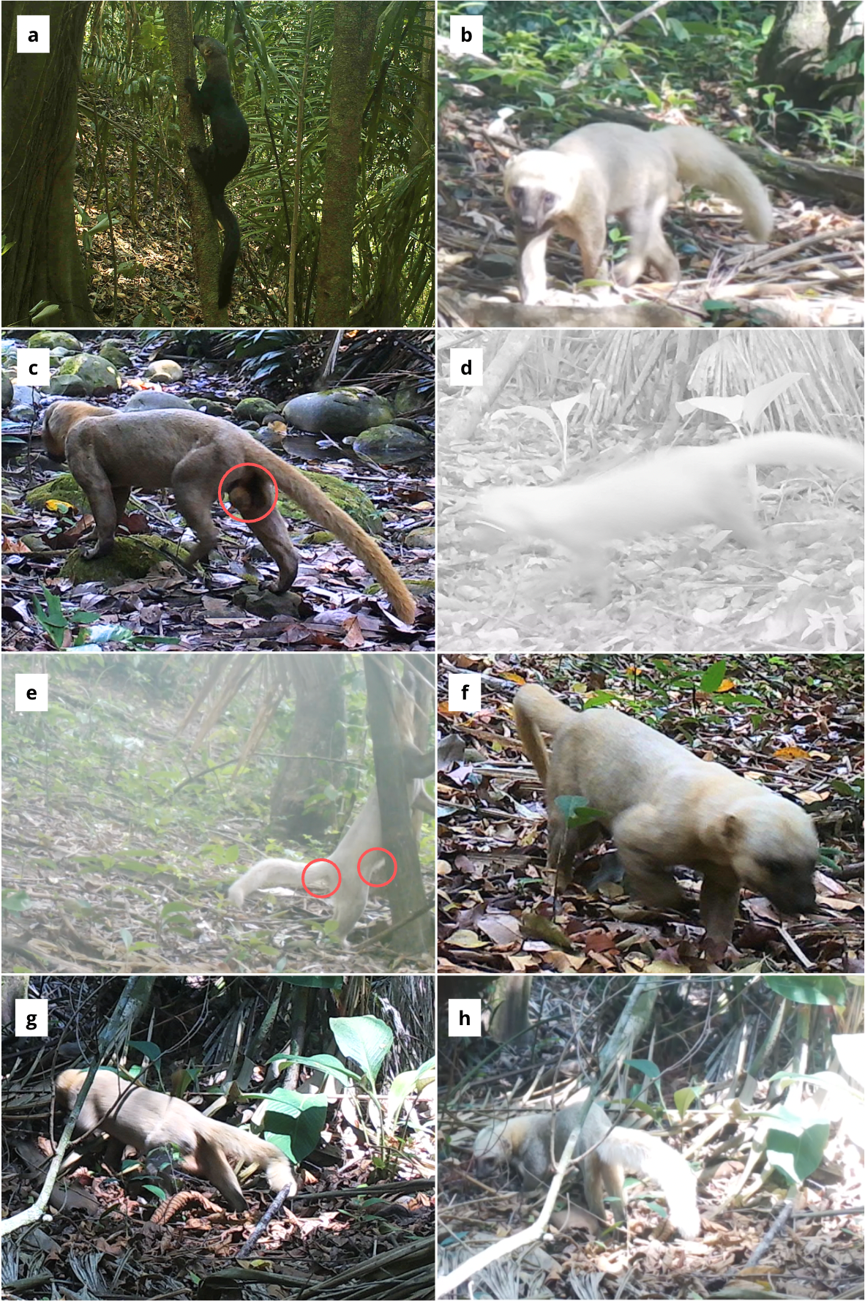
Tayras are relatively common and widely spread mammals in the Neotropics, however, their natural history is partially known. For example, even though their pelage coloration varies between dark-brown and black, and there are reports of pigmentation anomalies, causes and effects on their populations remain unknown. Consequently, documenting these cases is required along with relevant ecological information to improve the understanding of this phenomena. In this note we present the records of hypopigmented tayras obtained during a biodiversity monitoring in 15 conservation areas included within a community-based Dry Forest conservation strategy in the municipality of Tame (Arauca), and we discuss the distribution of this anomalies according to their age, seasonality, activity period and sex. For the monitoring we deployed 33 camera traps over a period of 27 months from 2021 to 2024. We recorded 36 tayra independent records, from which there was a highest number of adults showing xanthism, higher occurrence during the day and the dry season. We considered a record of a couple of hypopigmented individuals as a valuable contribution about interactions among tayras with pigmentation anomalies. Finally, we emphasize the importance of the natural history information generated by monitoring, beyond the species inventories and ecological data.
References
Alviz Á, Quintero G, Farfán-Ardila N, Pérez-Albarracín K. 2025. First record of leucism in a wild lowland tapir Tapirus terrestris (Linnaeus, 1758) from the Orinoquia region of Colombia. Notas sobre Mamíferos Sudamericanos 07(1):001–008. https://doi.org/10.31687/SaremNMS25.1156.
Arango-Lozano J, Angarita-Corzo K. 2025. First record of albinism in Leopardus pardalis (Linnaeus, 1758) in Colombia: conservation implications and captive management. Notas sobre Mamíferos Sudamericanos 07(1):001–008. https://doi.org/10.31687/SaremNMS25.1149.
Araujo Perini F, Sicuro FL. 2025. Sex- and age-related morphological and functional differences in the skull of Eira barbara (Linnaeus, 1758) (Carnivora, Mustelidae). PeerJ 13:e19730. https://doi.org/10.7717/peerj.19730.
Aya-Cuero CA, Molina-Vargas BA, Stasiukynas DC, Páez-Vásquez M, Pantoja-Peña G, Cáceres-Martínez CH, Pardo LE. 2025. First records of hypopigmentation of Tayra Eira barbara in Colombia Primeros registros de hipopigmentación en la taira Eira barbara en Colombia. Therya notes 6:55–60. https://doi.org/10.12933//therya_notes-25-199
Castillo-Figueroa D, Martínez-Medina D, Rodríguez-Posada ME. 2021. Activity patterns of medium and large mammals in two savanna ecosystems in the Colombian Llanos. Revista de la Academia Colombiana de Ciencias Exactas, Físicas y Naturales 45(177):1071-1083 https://doi.org/10.18257/raccefyn.1461.
Castillo-Figueroa D, Martínez-Medina D, Rodríguez-Posada ME, Bernal-Vergara S. 2019. Structural differences in mammal assemblages between savanna ecosystems of the Colombian Llanos. Papéis Avulsos de Zoologia 59:e20195914. https://doi.org/10.11606/1807-0205/2019.59.14.
DigiKam Team. 2025. DigiKam Professional Photo Management with the Power of Open Source. https://www.digikam.org/
Gómez H, Wallace RB, Ayala G, Tejada R. 2005. Dry season activity periods of some Amazonian mammals. Studies on Neotropical Fauna and Environment 40(2):91–95. https://doi.org/10.1080/01650520500129638.
Henao-Fernandez L, Sánchez F, Alvarez SJ. 2024. Registro de leucismo en Dasyprocta fuliginosa (Rodentia: Dasyproctidae) en la Orinoquia colombiana. MaNo 10(2):404. https://doi.org/10.47603/mano.v10n2.404
Kaufmann JH, Kaufmann A. 1965. Observations of the behavior of Tayras and Grisons. Zeitschrift für säugetierkunde 30:146–155.
Marin-Vasquez A, Ortega-Rincón M, Ramírez-Chaves HE. 2010. Records of leucism in three species of Colombian bats: Carollia brevicauda, Artibeus jamaicensis and Lophostoma silvicolum (Phyllostomidae). Chiroptera Neotropical 16(2):706–709.
Mendes Pontes AR, Da Silva Júnior AP, Chivers D. 2020. The occurrence of leucism in groups of tayras Eira barbara Linnaeus 1758 on the Guyana shield. Écoscience 27(4):295–301. https://doi.org/10.1080/11956860.2020.1804724.
Montoya-Bustamante S, Zapata-Mesa N, Murillo-García OE. 2017. Leucism in Akodon affinis (Allen, 1912) (Rodentia: Cricetidae). Therya 8(3):269–272. https://doi.org/10.12933/therya-17-494.
Pinheiro-Costa NC, Norris D. 2025. Leucism occurrence frequency in an island population of tayra (Eira barbara) in Roraima, Brazil: A comparative analysis with camera trap records. Acta Amazonica 55: e55bc23368. https://doi.org/10.1590/1809-4392202303681
Portillo-Quintero CA, Sánchez-Azofeifa GA. 2010. Extent and conservation of tropical dry forests in the Americas. Biological Conservation 143(1):144–155. https://doi.org/10.1016/j.biocon.2009.09.020.
Presley SJ. 2000. Eira barbara. Mammalian Species 636(1):1–6. DOI:10.2307/0.636.1
Ramos Velásquez LI, Trujillo Calderón W. 2025. Estructura y diversidad florística en bosques secos de la Orinoquia en Tame, Arauca, Colombia. Caldasia 47:e111220. https://doi.org/10.15446/caldasia.v47.111220.
Rodríguez-Mahecha JV, Hernández-Camacho JI, Defler TR, Alberico M, Mast RB, Mittermeier RA, Cadena A. 1995. Mamíferos colombianos: sus nombres comunes e indígenas. Occasional Papers in Conservation Biology, Conservation International 3, 1-56.
Roncancio N, Ramírez-Chaves HE. 2008. Registro de leucismo en Sturnira erythromos en los Andes centrales de Colombia. Chiroptera Neotropical 14(2):412–414.
Scrich VM, Pônzio MC, Pasqualotto N, Rodrigues TF, Paolino RM, Chiarello AG. 2019. Occurrence of tayras (Eira barbara Linnaeus, 1758) with anomalous coloration in Cerrado remnants in the state of São Paulo, Brazil. Biota Neotropica 19(3):e20180680. https://doi.org/10.1590/1676-0611-bn-2018-0680.
Sobroza TV, Gonçalves AL, Dos Santos LS. 2016. Predation attempt and abnormal coat coloration of the tayra (Eira barbara) in the Brazilian Central Amazon. Studies on Neotropical Fauna and Environment 51(3):231–234. https://doi.org/10.1080/01650521.2016.1227137.
Suárez-Castro AF, Ramírez-Chaves HE (eds). 2015. Los carnívoros terrestres y semiacuáticos continentales de Colombia. Guía de Campo. Editorial Universidad Nacional de Colombia. Bogotá, Colombia.
Talamoni S, Viana PIM, Costa CG, Palú L, Oliveira RB, Pessôa LM. 2017. Occurrence of leucism in Eira barbara (Carnivora, Mustelidae) in Brazil. Biota Neotropica 17(3):e20170328. https://doi.org/10.1590/1676-0611-BN-2017-0328
Tortato FR, Althoff SL. 2007. Variações na coloração de iraras (Eira barbara Linnaeus, 1758 - Carnivora, Mustelidae) da Reserva Biológica Estadual do Sassafrás, Santa Catarina, sul do Brasil. Biota Neotropica. 7(3):365–367. https://doi.org/10.1590/S1676-06032007000300038.
Trujillo F, Anzola F. 2019. Biodiversidad en el departamento de Arauca. Gobernación de Arauca, Fundación Omacha y Fundación Ecollano.
Velandia-Perilla JH, Yusti-Muñoz AP, Sánchez-Martínez MA, Giraldo A. 2013. Leucismo en murciélagos de hoja nasal (Chiroptera, Phyllostomidae) de Colombia. Boletín Científico Centro de Museos Museo de Historia Natural 17(2):87–94.
Villafañe-Trujillo Á, López-González C, Kolowski J. 2018. Throat Patch Variation in Tayra (Eira barbara) and the Potential for Individual Identification in the Field. Diversity 10(1):7. https://doi.org/10.3390/d10010007
Wilson DE, Mittermeier RA. 2009. Mustelidae, Handbook of the Mammals of the World – Volume 1 Carnivores, Barcelona: Lynx Edicions, pp. 564-656

This work is licensed under a Creative Commons Attribution 4.0 International License.