

Keywords
scavenging
omnivorous diet
paca
white-nosed coati
How to Cite
Accepted 2025-12-02
Published 2026-07-22



Abstract
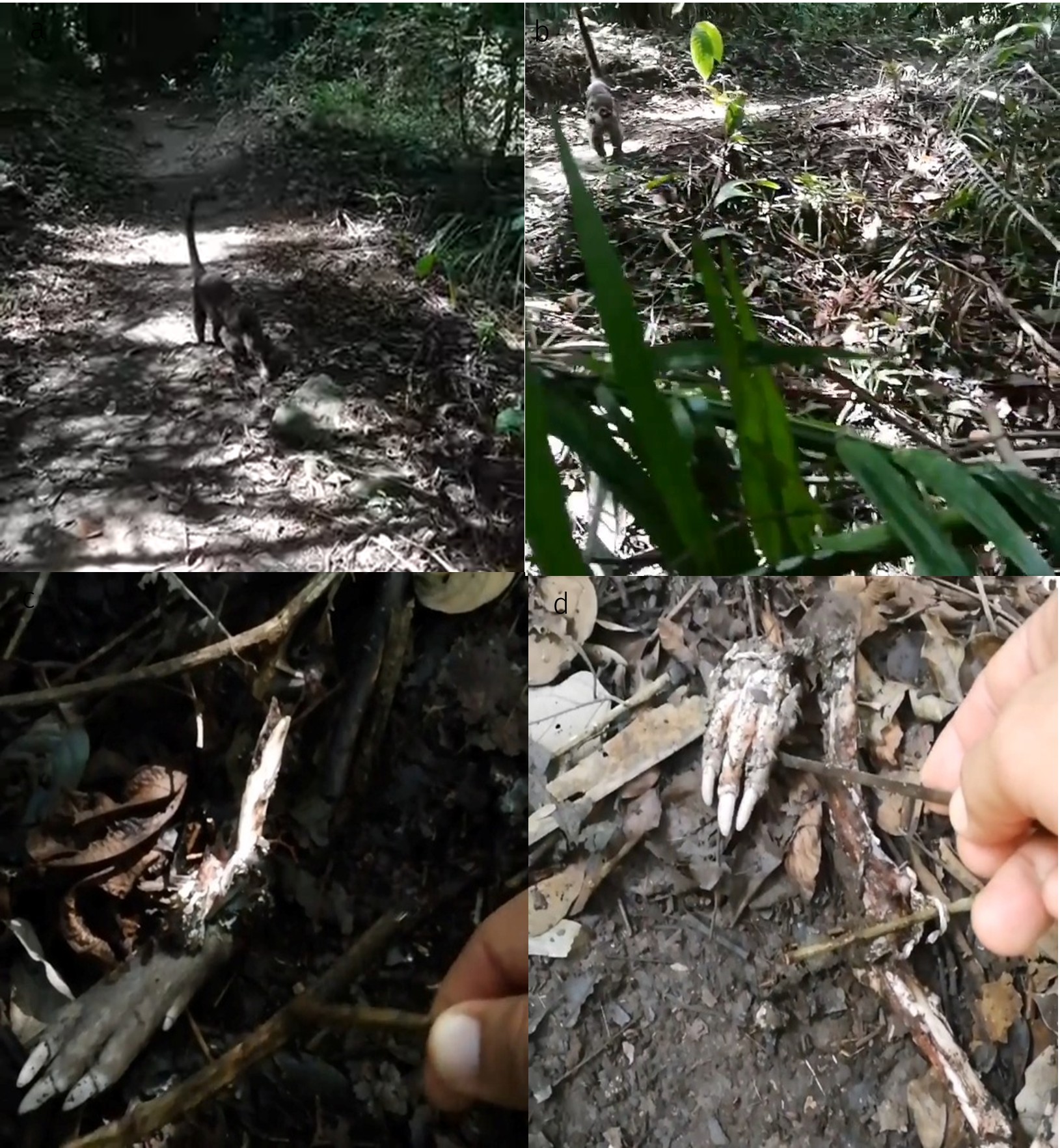
The pizote or white-nosed coati Nasua narica (Carnivora: Procyonidae) is an omnivorous species widely distributed throughout the American continent, with a diet primarily composed of invertebrates and fruits. On September 7, 2019, during a field survey in Cabo Blanco Absolute Nature Reserve, Costa Rica, a male individual was observed and recorded scavenging from the decomposing remains of a paca Cuniculus paca (Rodentia: Cuniculidae). The remains were identified from the animal’s limbs. The coati's good physical condition suggests that this behavior reflects an opportunistic feeding strategy rather than a response to weakness. This observation constitutes the first documented evidence of scavenging by N. narica in Costa Rica and reinforces its generalist dietary habits. Documenting this type of interaction contributes to understanding the species’ trophic ecology in tropical ecosystems.
References
Altamirano A, Soriano M, Maldonado M. 2013. Alimentación del coatí Nasua narica, en la comunidad de Las Ánimas, Municipio de Chapa de Mota, Estado de México - México. Revista de Zoología 24:16–26.
Artavia A. 2015. Diagnóstico de estudios con cámaras trampa en Costa Rica (1998–mayo 2015). Proyecto MAPCOBIO (SINAC, MINAE y JICA). Heredia, Costa Rica.
Cuarón AD, Helgen K, Reid F, Pino J, González-Maya JF. 2016. Nasua narica. The IUCN Red List of Threatened Species 2016: e.T41683A45216060. https://dx.doi.org/10.2305/IUCN.UK.2016-1.RLTS.T41683A45216060.en
DeVault TL, Rhodes OE Jr, Shivik JA. 2003. Scavenging by vertebrates: behavioral, ecological, and evolutionary perspectives on an important energy transfer pathway in terrestrial ecosystems. Oikos 102(2):225–234. https://doi.org/10.1034/j.1600-0706.2003.12378.x
Fonda F, Vezzani L, Mena Aguilar LA, Romero G, Sonetti D, Dal Zotto M. 2022. Investigating ecotourism impacts on mammal activity in a Costa Rican protected area. Hystrix 33(suppl.):79.
Gompper M. 1995. Nasua narica. Mammalian Species 487:1–10. https://doi.org/10.2307/3504195
González-Maya JF, Schipper J, Benítez A. 2009. Activity patterns and community ecology of small carnivores in the Talamanca region, Costa Rica. Small Carnivore Conservation 41:9–14.
Kaufmann JH, Lanning DV, Poole SC. 1976. Current status and distribution of the coati in the United States. Journal of Mammalogy 57(4):621–637. https://doi.org/10.2307/1379435
Romero A. 2020. The fate of small-mammal carrion is affected by carcass size and visual conspicuousness in a Neotropical rainforest. Therya 11(3):423–431. https://doi.org/10.12933/therya-20-988
Sebastián-González E, Morant J, Moleón M, Redondo-Gómez D, Morales-Reyes Z, Pascual-Rico R, Pérez-García JM, Arrondo E. 2023. The underestimated role of carrion in vertebrates' diet studies. Global Ecology and Biogeography 32:1302–1310. https://doi.org/10.1111/geb.13707
Sistema Nacional de Áreas de Conservación (SINAC). 2009. Plan de Manejo de la Reserva Natural Absoluta Cabo Blanco 2010–2014. Área de Conservación Tempisque. Documento técnico sin publicar. Guanacaste, Costa Rica.
Sistema Nacional de Áreas de Conservación (SINAC). 2017. R-SINAC-CONAC-092-2017. Lista oficial de especies en peligro de extinción y con poblaciones reducidas y amenazadas. La Gaceta Nº 187, Alcance 239.
Timm RM, Lieberman D, Lieberman M, McClearn D. 2009. Mammals of Cabo Blanco: History, diversity, and conservation after 45 years of regrowth of a Costa Rican dry forest. Forest Ecology and Management 258(6):997–1013. https://doi.org/10.1016/j.foreco.2008.10.027
Valenzuela D. 1998. Natural history of the white-nosed coati, Nasua narica, in a tropical dry forest of western Mexico. Revista Mexicana de Mastozoología 3:26–44. https://doi.org/10.22201/ie.20074484e.1998.3.1.59
Vaughan C. 1984. Estimación de las poblaciones de algunos mamíferos en el Parque Nacional Manuel Antonio, Costa Rica. Brenesia 22:207–217.
Wallmo OC, Gallizioli S. 1954. Status of the Coati in Arizona. Journal of Mammalogy 35(1):48–54. https://doi.org/10.2307/1376072
Wilson EE, Wolkovich EM. 2011. Scavenging: how carnivores and carrion structure communities. Trends in Ecology & Evolution 26(3):129–135. https://doi.org/10.1016/j.tree.2010.12.011

This work is licensed under a Creative Commons Attribution 4.0 International License.