

Supplementary Files
Keywords
ecolocation
insectivorous bat
Vesperilionidae
wav
murciélago
How to Cite
Accepted 2025-09-23
Published 2025-11-24



Abstract
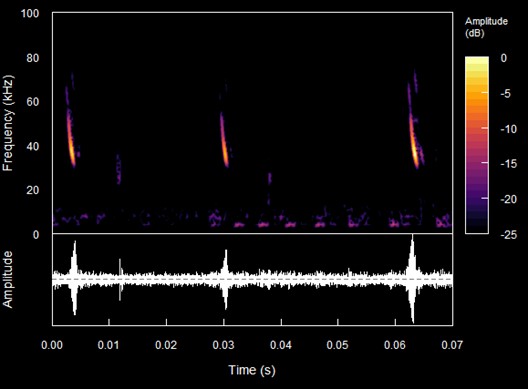
A major challenge in bioacoustic research remains the limited availability of reference recordings documenting intraspecific variation in emitted signals - a critical requirement for reliable species identification. This issue is particularly acute for insectivorous species, which exhibit low capture rates using conventional mist-netting methods, thereby restricting opportunities to obtain definitive acoustic signatures. Such data gaps are especially problematic in megadiverse countries like Colombia, where recent expansions in acoustic monitoring are enabling novel ecological and behavioral investigations. We present the first characterization of echolocation signals from Lasiurus ega (Chiroptera: Vespertilionidae) in Puerto Wilches, Santander Department, Colombia. Our flight chamber recordings (n=6) reveal that L. ega produces distinctive frequency-modulated (FM) downward sweeps with minimum frequencies of 30,92 ± 2,85 kHz.
References
Arias-Aguilar A, Hintze F, Aguiar LM, Rufray V, Bernard E, Pereira MJR. 2018. Who’s calling? Acoustic identification of Brazilian bats. Mammal Research 63:231-253. https://doi.org/10.1007/s13364-018-0367-z
Baird AB, Braun JK, Engstrom MD, Lim BK, Mares MA, Patton JC, Bickham JW. 2021. On the utility of taxonomy to reflect biodiversity: the example of Lasiurini (Chiroptera: Vespertilionidae). Therya 12(2):283-289. https://doi.org/10.12933/therya-21-1117
Carter TC, Menzel JM. 2007. Behavior and day-roosting ecology of North American foliage-roosting bats. In: Lacki MJ, Hayes JP, Kurta A, editors. Conservation and management of bats in forests. Baltimore (MD): Johns Hopkins University Press. p. 61-81.
Corcoran AJ, Weller TJ. 2018. Inconspicuous echolocation in hoary bats (Lasiurus cinereus). Proceedings of the Royal Society B: Biological Sciences 285(1878). https://doi.org/10.1098/rspb.2018.0441
Corcoran AJ, Weller TJ, Hopkins A, Yovel Y. 2021. Silence and reduced echolocation during flight are associated with social behaviors in male hoary bats (Lasiurus cinereus). Scientific Reports 11(1). https://doi.org/10.1038/s41598-021-97628-2
Díaz MM, Solari S, Gregorin R, Aguirre LF, Barquez RM. 2021. Clave de identificación de los murciélagos neotropicales. Tucumán (Argentina): Programa de Conservación de los Murciélagos de Argentina. Publicación Especial No. 4.
Francis CM, Simmons NB, Cakenberghe V, Upham NS, Burgin CJ. 2023. On the taxonomy of Lasiurus on behalf of the Global Bat Taxonomy Working Group of the IUCN SSC Bat Specialist Group. Zenodo. https://doi.org/10.5281/zenodo.7696845.
Gardner AL, Handley CO. 2007. Order Chiroptera: Family Vespertilionidae: Genus Lasiurus Gray, 1831. In: Gardner AL, editor. Mammals of South America. Volume 1: Marsupials, Xenarthrans, Shrews, and Bats. Chicago (IL): University of Chicago Press. p. 457-468..
Hernández-Leal OF, Sánchez F, Lizcano DJ. 2021. Murciélagos insectívoros aéreos en un paisaje ganadero del piedemonte llanero colombiano. Biota Colombiana 22(1):164-183. https://doi.org/10.21068/c2021.v22n01a11
Kalko EKV, Estrada-Villegas S, Schmidt M, Wegmann M, Meyer CFJ. 2008. Flying high - Assessing the use of the aerosphere by bats. Integrative and Comparative Biology 48(1):60–73. https://doi.org/10.1093/icb/icn030
Kraker C, Pérez S. 2012. Detección ultrasónica de murciélagos insectívoros en cafetales de La Antigua Guatemala, Guatemala. Revista Científica 22:43–53. https://doi.org/10.54495/Rev.Cientifica.v22i1.122
Leiser‐Miller LB, Santana SE. 2021. Functional differences in echolocation call design in an adaptive radiation of bats. Ecology and Evolution 11(22):16153-16164. https://doi.org/10.1002/ece3.8296
MacSwiney MC, Clarke FM, Racey PA. 2008. What you see is not what you get: the role of ultrasonic detectors in increasing inventory completeness in Neotropical bat assemblages. Journal of Applied Ecology 45(5):1364-1371. https://doi.org/10.1111/j.1365-2664.2008.01531.x
Mammal Diversity Database. 2024. Mammal Diversity Database. https://www.mammaldiversity.org/. Accessed 2025 Aug 13.
Martínez-Medina D, Sánchez J, Zurc D, Sánchez F, Otálora-Ardila A., Restrepo-Giraldo C, Lizcano DJ. 2021. Estándares para registrar señales de ecolocalización y construir bibliotecas de referencia de murciélagos en Colombia. Biota Colombiana 22(1):36-56. https://doi.org/10.21068/c2021.v22n01a03
O'Farrell MJ, Miller BW. 1999. Use of vocal signatures for the inventory of free‐flying Neotropical bats. Biotropica 31(3):507-516. https://doi.org/10.1111/j.1744-7429.1999.tb00394.x
Ortega J, MacSwiney C, Zamora V. 2022. Compendio de los llamados de ecolocalización de los murciélagos insectívoros mexicanos. Ciudad de México (México): Asociación Mexicana de Mastozoología, AC y CONABIO. p. 24-217
Ramírez-Chaves HE, Leuro-Robles NG, Castaño-Rivera A, Morales-Martínez DM, Suárez-Castro AF, Rodríguez-Posada ME, Zurc D, Concha-Osbahr DC, Trujillo A, Noguera-Urbano EA, Pantoja-Peña GE, González-Maya JF, Pérez-Torres J, Mantilla-Meluk H, López-Castañeda C, Velásquez-Valencia A, Zárrate-Charry D. 2024. Mamíferos de Colombia. v1.14. Bogotá (Colombia): Sociedad Colombiana de Mastozoología. Dataset/Checklist. https://doi.org/10.15472/kl1whs
Ramírez-Chaves HE, Morales-Martínez DM, Martínez-Medina D, Ossa-López PA, Rivera-Páez FA. 2023. Revising the diversity within the Dwarf Dog-faced Bat, Molossops temminckii (Chiroptera, Molossidae), with the revalidation of the endangered Molossops griseiventer. ZooKeys 1180:237-260. https://doi.org/10.3897/zookeys.1180.109091
Rodríguez-Posada ME, Morales-Martínez DM, Ramírez-Chaves HE, Martínez-Medina D, Calderón-Acevedo CA. 2021. A new species of long-eared brown bat of the genus Histiotus (Chiroptera) and the revalidation of Histiotus colombiae. Caldasia 43(2):221-234. https://doi.org/10.15446/caldasia.v43n2.85424
Rydell J, Arita HT., Santos M, Granados J. 2002. Acoustic identification of insectivorous bats (Order Chiroptera) of Yucatán, Mexico. Journal of Zoology 257(1):27-36. https://doi.org/10.1017/S0952836902000626
Siemers BM. 2004. Bats in the field and in a flight cage: recording and analysis of their echolocation calls and behavior. In: Thomas JA, Moss CF, Vater M, editors. Bat echolocation research: tools, techniques, and analysis. New York (NY): Springer. p. 107-113.
Sikes RS, Animal Care and Use Committee of the American Society of Mammalogists. 2016. Guidelines of the American Society of Mammalogists for the use of wild mammals in research and education. Journal of Mammalogy 97(3):663-688. https://doi.org/10.1093/jmammal/gyw078
Yang LK, Center for Conservation Bioacoustics. 2014. Raven Pro: Interactive Sound Analysis Software (Version 1.6.1) [Computer software]. Ithaca (NY): Cornell Lab of Ornithology. https://ravensoundsoftware.com/.
Yantén AV, Cruz-Roa A, Sánchez FA. 2022. Traffic noise affects foraging behavior and echolocation in the lesser bulldog bat, Noctilio albiventris (Chiroptera: Noctilionidae). Behavioural Processes 203:104775. https://doi.org/10.1016/j.beproc.2022.104775

This work is licensed under a Creative Commons Attribution 4.0 International License.