

Keywords
Tail
Colombia
Rodents
How to Cite
Accepted 2024-07-22
Published 2024-08-03



Abstract
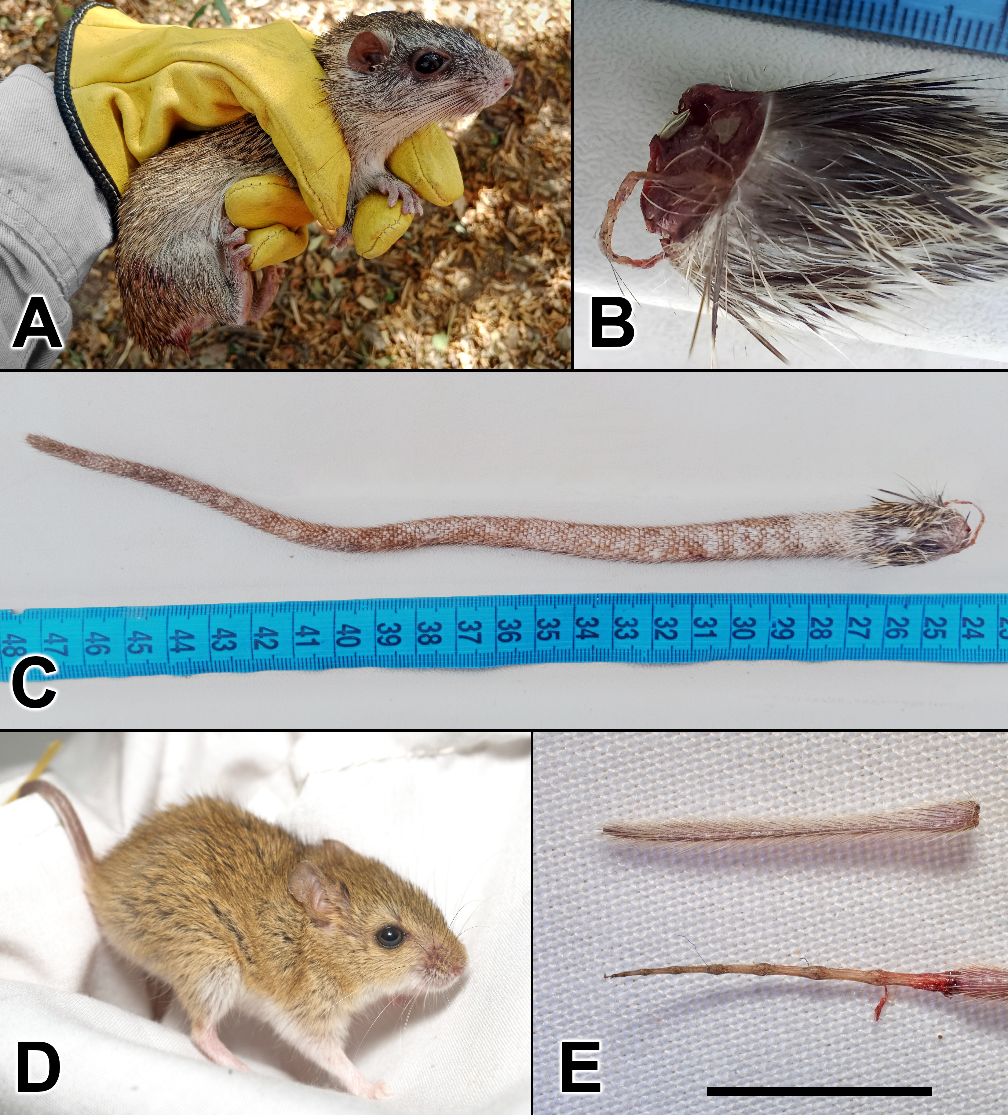
Tail autotomy is rare among mammals, mainly observed in rodents. This note reports two new cases in the Colombian Speckled Tree Rat (Pattonomys semivillosus) and Hummelinck’s vesper mouse (Calomys hummelincki). P. semivillosus displays real autotomy, dropping its entire tail when grabbed, akin to lizard behavior. C. hummelincki exhibits fake autotomy, shedding only the tail tip, exposing the last eight vertebrae. These observations add to the limited knowledge of autotomy in rodents, increasing the known species count to 49.
References
Allen GM. 1917. Fossil mammals from Cuba. Bulletin of the Museum of Comparative Zoology at Harvard College 61:3–5.
Cuenot ML. 1907. L'autotomie caudale chez quelques mammiferes du groupe des rongeurs. Comptes rendus des séances de la Société de biologie et de ses filiales 62:174–176.
Dubost G, Gasc JP. 1987. The process of total tail autotomy in the South‐American rodent, Proechimys. Journal of Zoology 212:563–572. https://doi.org/10.1111/j.1469-7998.1987.tb02924.x
Dunaway PB, Kaye SV. 1961. Studies of small-mammal populations on the radioactive white oak lake bed. Transactions of the North American Wildlife and Natural Resources Conference 26:167–185.
Emberts Z, Escalante I, Bateman PW. 2019. The ecology and evolution of autotomy. Biological Reviews 94:1881–1896. https://doi.org/10.1111/brv.12539
Emmons LH, Patton JL. 2015. Genus Pattonomys. In: Patton JL, Paridas U, D’Elía G, editors. Mammals of South America. Chicago, USA: The University of Chicago Press. p. 910–915.
Emmons LH, Fabre PH. 2018. A review of the Pattonomys/Toromys clade (Rodentia: Echimyidae), with descriptions of a new Toromys species and a new genus. American Museum Novitates 3894:1–52. https://doi.org/10.1206/3894.1
Eisenberg JF. 1989. Mammals of the Neotropics. The Northern Neotropics. Londo, UK and Chicago, USA: The University of Chicago Press.
Fredericq L. 1883. About autotomy or mutilation by reflex as a defense mean of animals. Archive de Zoologie Expérimentale et Générale 1:413–426.
Fulk GW. 1975. Population ecology of rodents in the semiarid shrublands of Chile. Occasional Papers Museum of Texas Tech University 39:549–554. https://doi.org/10.5962/bhl.title.142959
Gögl H. 1930. Zur frage der schwanzaütotomie bei nagern. Zeitschrift für Morphologie und Ökologie der Tiere 19:135–143. https://www.jstor.org/stable/43261281
Hosotani M, Nakamura T, Ichii O, Irie T, Sunden Y, Elewa YHA, Watanabe T, Ueda H, Mishima T, Kon Y. 2021. Unique histological features of the tail skin of cotton rat (Sigmodon hispidus) related to caudal autotomy. Biology Open 10:bio058230. https://doi.org/10.1242/bio.058230
Itescu Y, Schwarz R, Meiri S, Pafilis P. 2017. Intraspecific competition, not predation, drives lizard tail loss on islands. Journal of Animal Ecology 86:66–74. https://www.jstor.org/stable/45024142
Iwasa MA, Hasegawa A. 2022. Caudal vertebral fragilities related to loss of a tail part in two species of the Japanese field mice. Mammal Study 47:125–131. https://doi.org/10.3106/ms2020-0056
Jaksic FM, Simonetti JA. 1987. Predatory/prey relationships among terrestrial vertebrates: an exhaustive review of studies conducted in southern South America. Revista Chilena de Historia Natural 60:221–244.
Kelehear C, Webb JK. 2006. Effects of Tail Autotomy on Anti-predator Behavior and Locomotor Performance in a Nocturnal Gecko. Copeia 4:803–809. https://doi.org/10.1643/0045-8511(2006)6[803:EOTAOA]2.0.CO;2
Layne JN. 1972. Tail autotomy in the Florida mouse, Peromyscus floridanus. Journal of Mammalogy 53:62–71. https://doi.org/10.2307/1378827
McKee RC, Adler GH. 2002. Tail autotomy in the Central American spiny rat, Proechimys semispinosus. Studies on Neotropical Fauna and Environment 37:181–185. https://doi.org/10.1076/snfe.37.3.181.8568
Michener GR. 1976. Tail autotomy as an escape mechanism in Rattus rattus. Journal of Mammalogy 57:600–603. https://doi.org/10.2307/1379315
Mohr E. 1941. Schwanzverlust und Schwanzregeneration bei Nagetieren. Zoologischer Anzeiger 135:49–65.
Nowak RM. 1991. Wlaker’s mammals of the World. 5th ed. Baltimore, USA: The Johns Hopkins University Press.
Pearson OP. 1948. Life history of mountain viscachas in Peru. Journal of Mammalogy 29:345–374. https://doi.org/10.2307/1375125
Redford KH, Eisenberg JF. 1992. Mammals of the Neotropics. 2nd ed. Chicago, USA: The University of Chicago Press.
Ride WDL. 1970. A guide to the native mammals of Australia. Melbourne, AUS: Oxford University Press.
Robinson N. 1967. Tamed squirrels. Nigerian Field 32:42–46.
Sánchez-Giraldo C, Delgado-V CA. 2009. Dos nuevos casos de autotomía caudal en roedores suramericanos. Mastozoología Neotropical. 16:481–484.
Shargal E, Rath-Wolfson L, Kronfeld N, Dayan T. 1999. Ecological and histological aspects of tail loss in spiny mice (Rodentia: Muridae, Acomys) with a review of its occurrence in rodents. Journal of Zoology 249:187–193. https://doi.org/10.1111/j.1469-7998.1999.tb00757.x
Sumner FB, Collins HH. 1918. Autotomy of the tail in rodents. The Biological Bulletin 34:1–6. https://doi.org/10.2307/1536244
Walker EP. 1968. Mammals of the world. 2nd ed. Baltimore, USA: The Johns Hopkins Press.
Weir BJ. 1973. Another hystricomorph rodent: keeping casiragua (Proechimys guairae) in captivity. Laboratory animals 7:125–134. https://doi.org/10.1258/002367773781008687
Emmons LH, Patton JL. 2015. Genus Pattonomys. In: Patton JL, Paridas U, D’Elía G, editors. Mammals of South America. Chicago, USA: The University of Chicago Press. p. 910–915.
Wilderson M, Manrique-Valderrama NT, Avila JAM, Gil-Novoa JE, Gil-Leguizamón PA. 2018. Capítulo VIII. Disponibilidad de alimento. In: Gil-Novoa JE, Gil-Leguizamón PA, Morales-Puentes ME, editors, La vida en fragmento de bosque en las rocas: una muestra la diversidad andina en Bolívar, Santander. Tunja, Colombia: Editorial UPTC. p. 359–376
Wood CA, Boraker DK. 1975. Octodon degus. Mammalian Species 67:1–5. https://doi.org/10.2307/3503820.

This work is licensed under a Creative Commons Attribution 4.0 International License.