

Keywords
chromatic aberrations
Genetic alterations
Orinoquia high plains
pigmentation
How to Cite
Accepted 2024-05-20
Published 2024-08-02



Abstract
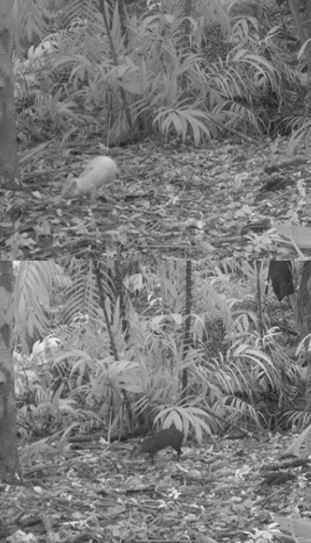
Among wild mammals, the occurrence of atypical coloration patterns such as leucism is rare. The records of such coloration patterns contribute to a better understanding of this phenomenon and possibly to assess the status of wild populations, considering that the occurrence of leucism has been linked to endogamic processes or environmental stress. In this note, we present the first report of leucism in Dasyprocta fuliginosa in Colombia, particularly in the high plains region of Vichada, in the Colombian Orinoco basin. We used camera traps during a study on mammals associated to cashew crop landscapes in the high plains of the Colombian Orinoquia. We recorded an individual of D. fuliginosa with partial leucism, ~90% of the body. The individual was seen on one occasion accompanied by two young, suggesting it was a female that successfully reproduced, despite the potentially disadvantageous coloration compared to typical wild colorations.
References
Abreu MS, Machado R, Barbieri F, Freitas NS, Oliveira LR. 2013. Anomalous colour in Neotropical mammals: a review with new records for Didelphis sp. (Didelphidae, Didelphimorphia) and Arctocephalus australis (Otariidae, Carnivora). Brazilian Journal of Biology 73: 185-194. https://doi.org/10.1590/S1519-69842013000100020
Acevedo J, Aguayo M. 2008. Leucistic South American sea lion in Chile, with a review of anomalously color in otariids. Revista de Biologia Marina y Oceanografia 43: 413-417. http://dx.doi.org/10.4067/S0718-19572008000200017
Arriaga-Flores JC, Rodríguez-Ruíz ER, Gallo-Reynoso JP, Castro-Arellano I. 2016. Leucism in neotropical otters (Lontra longicaudis annectens) from Mexico. The Southwestern Naturalist 61: 63-68. https://doi.org/10.1894/0038-4909-61.1.63
Barreto HF, Meneses YR, Galina AB, Ferrari SF, Beltrão-Mendes R. 2023. Leucism in rodents: the first record for the mocó (Kerodon rupestris Wied-Neuwied, 1820), a rodent endemic to Brazil. Notas sobre Mamíferos Sudamericanos Vol. 5. https://doi.org/10.31687/SaremNMS23.6.3
Barros‐Diaz C, Vela S, Gallo‐Pérez A, Chiquito M, Cornejo X, Mosquera‐Muñoz D, Perez‐Correa J. 2022. Hypopigmentation in mantled howler monkeys Alouatta palliata (gray 1849): First documented cases of whole‐body leucism in South America. Ecology and Evolution 12: e9628. https://doi.org/10.1002/ece3.9628
Beninato VA, Rivero-Castro G A, Pérez MA, Borghi CE, Giannoni SM. 2020. First records of leucism in small rodents for Argentina. Therya Notes 1: 62-66. https://doi.org/10.12933/therya_notes-20-15
Bensch S, Hansson B, Hasselquist D, Nielsen B. 2000. Partial albinism in a semi‐isolated popula-tion of great reed warblers. Hereditas 133: 167-170.
https://doi.org/10.1111/j.1601-5223.2000.t01-1-00167.x
Brito J, León C. 2014. Primer caso de albinismo en Vampyrum spectrum (Chiroptera: Phyllostomidae) para Ecuador. Mammalogy Notes 1: 14-15. https://doi.org/10.47603/manovol1n2.14-15
Camargo I, Rios E, Cornejo-Latorre C, Álvarez-Castañeda ST. 2014. First record of leucism in the genus Peromyscus (Mammalia: Rodentia). Western North American Naturalist 74: 366-368. https://doi.org/10.3398/064.074.0301
Caro T. 2005. The adaptive significance of coloration in mammals. BioScience 55: 125-136. https://doi.org/10.1641/0006-3568(2005)055[0125:TASOCI]2.0.CO;2
Cruz-Antía D, Gómez JR. 2010. Aproximación al uso y tráfico de fauna silvestre en Puerto Carreño, Vichada, Colombia. Ambiente y Desarrollo 14: 64–94.
da Silva Oliveira L, Varjão IC, Pereira L, Nicola-Pereira PA. 2019. Primeiro registro de leucismo no cachorro-do-mato Cerdocyon thous (Linnaeus, 1766) (Carnivora: Canidae) no Brasil. Biotemas 32: 93-98. https://doi.org/10.5007/2175-7925.2019v32n1p93
de Oliveira S. 2009. Albinismo parcial em cutia Dasyprocta azarae (Lichtenstein, 1823) (Rodentia, Dasyproctidae), no sul do Brasil. Biotemas 22: 243-246. https://doi.org/10.5007/2175-7925.2009v22n4p243
García-Morales R, Gordillo-Chávez EJ, Bello-Gutiérrez J. 2010. Primer registro de albinismo en Glossophaga soricina (Phyllostomidae) en México. Chiroptera Neotropical 16: 743-747.
Geiger D, Pacheco SM. 2006. Registro de albinismo parcial em Nyctinomops laticaudatus (E. Geoffroy, 1805) (Chiroptera: Molossidae) no Sul do Brasil. Chiroptera Neotropical 12: 250-254.
Gorta SB, Alting B, Claridge A, Henderson T. 2021. Apparent piebald variants in quolls (Dasyurus): Examples of three recent cases in the spotted-tailed quoll Dasyurus maculatus. Australian Mammalogy 43: 373-377. https://doi.org/10.1071/AM20058
Hoyos RO, Mejía Á, Stasiukynas D, Lizarazo J, Payán E. 2020. Primer registro de leucismo en Didelphis marsupialis Linnaeus, 1758 (Didelphimorphia: Didelphidae) en Colombia. Galemys 32: 64-68. https://doi.org/10.7325/Galemys.2020.N2
Jehl JR. 1985. Leucism in eared grebes in western North America. The Condor 87: 439-441. https://doi.org/10.2307/1367236
Jiménez P, Conn JE, Wirtz R, Brochero H. 2012. Anopheles (Díptera: Culicidae) vectors of malaria in Puerto Carreño municipality, Vichada, Colombia. Biomédica 32: 13– 21. https://doi.org/10.2307/1367236
Lamoreux ML, Delmas V, Larue L, Bennett D. 2010. The colors of mice: a model genetic network. (London: Wiley-Blackwell).
Mejía-Valenzuela EG. 2019. Primer registro de leucismo en Dasyprocta fuliginosa (Dasyproctidae, Rodentia) en Ecuador. Biota colombiana 20: 128-133. https://doi.org/10.21068/c2019.v20n02a10
Mena-Valenzuela P, Valdiviezo-Rivera J. 2016. Leucismo en Astroblepus ubidiai (Pellegrin 1931; Astroblepidae: Siluriformes), de la provincia de Imbabura, Ecuador. Biota colombiana 17: 131-136 https://doi.org/10.21068/C2016v17r01a10
Miller JD. 2005. All about albinism. Missouri Conservationist 66: 4-7.
Montilla SO, Link A. 2022. Albinism in a wild Caribbean night monkey (Aotus griseimembra) in a fragmented landscape in Colombia. Therya Notes 3: 14-17. https://doi.org/10.12933/therya_notes-22-62
Nations J, Mursyid A, Darma-Busta R, Adrian S, Handika H, Apandi A, Achmadi A, Esselstyn J. 2021. The first report of albinism in a Sundaland endemic rodent. Mammalia 85: 168-172. https://doi.org/10.1515/mammalia-2020-0047
Parsons GJ, Bondrup-Nielsen S. 1995. Partial albinism in an island population of Meadow Voles, Microtus pennsylvanicus, from Nova Scotia. Canadian field-Naturalist. Ottawa ON 109: 263-264. https://doi.org/10.5962/p.357626
Pathak A, Tamang A, Sintan B, Khanal S, Pathak B, Paudel P. 2023. First photographic record of albinism in chital (Axis axis) from Chitwan National Park, Nepal. Discovery 1018: 1– 4.
Robinson R. 1973. Acromelanic albinism in mammals. Genetica 44: 454-458. https://doi.org/10.1007/BF00161317
Romano MC, Montani ME, Cordini MC, Auil S. 2015. First record of albinism in Tadarida brasiliensis (Chiroptera: Molossidae) in South America and new records of leucism in central Argentina. Chiroptera Neotropical 21: 1312-1319.
Romero V, Tirira DG. 2017. Leucistic Antarctic fur seal (Arctocephalus gazella) at Robert Island, South Shetland Islands, Antarctica, with a note on colour morph nomenclature. Polar Biology 40: 1893-1897. https://doi.org/10.1007/s00300-016-2069-9
Romero V, Racines-Márquez CE, Brito J. 2018. A short review and worldwide list of wild albino rodents with the first report of albinism in Coendou rufescens (Rodentia: Erethizontidae). Mammalia 82: 509-515. https://doi.org/10.1515/mammalia-2017-0111
Talamoni S, Viana PI, Costa CG, Palú L, Oliveira RB, Pessôa LM. 2017. Occurrence of leucism in Eira barbara (Carnivora, Mustelidae) in Brazil. Biota Neotropica 17. https://doi.org/10.1590/1676-0611-BN-2017-0328
Tirira DG, Arbeláez E. 2020. Primer reporte de leucismo en un tapir amazónico (Perissodactyla, Tapiridae) nacido bajo cuidado humano. Mammalia aequatorialis 2: 85-88. https://doi.org/10.59763/mam.aeq.v2i.19
Zalapa SS, Guerrero S, Romero-Almaraz MD, Sánchez-Hernández C. 2016. Coloración atípica en murciélagos: frecuencia y fenotipos en Norte y Centroamérica e islas del Caribe y nuevos casos para México y Costa Rica. Revista Mexicana de Biodiversidad 87: 474-482. https://doi.org/10.1016/j.rmb.2016.04.007

This work is licensed under a Creative Commons Attribution 4.0 International License.